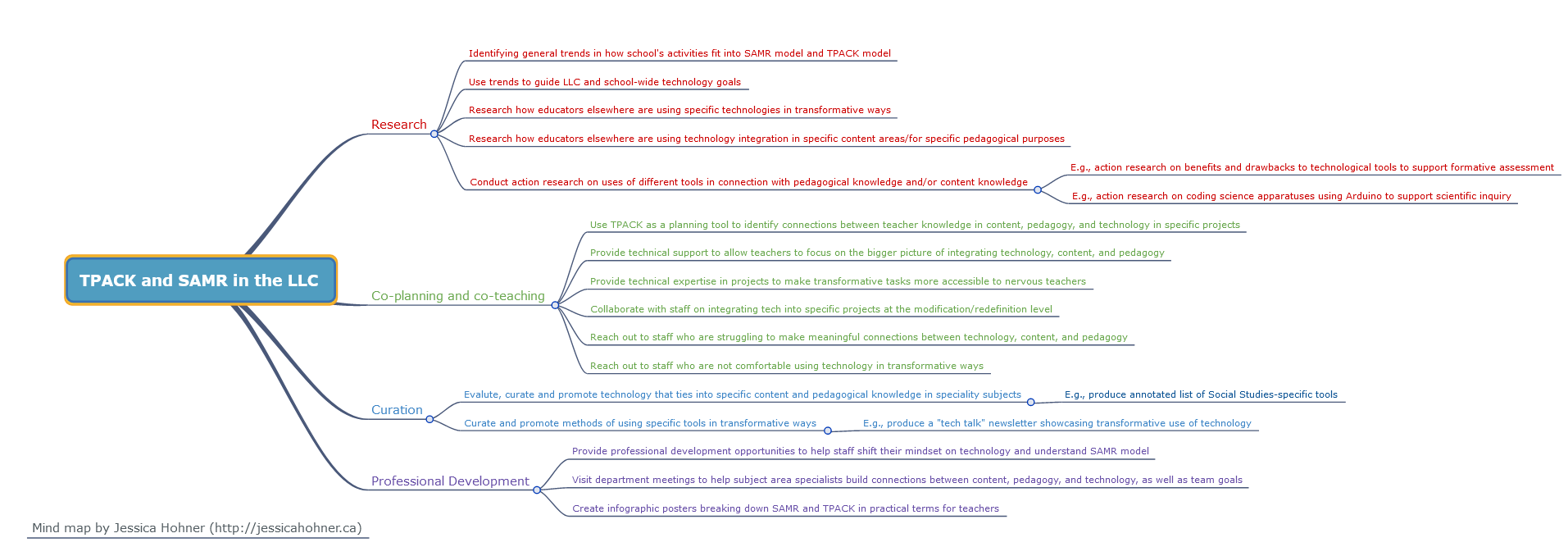
This is a different take on the subject than most folks I’ve seen in the course, which is always nerve-wracking. I used Wisemapping, which I was pleased to see was an open source project. There can never be enough FLOSS in EdTech! But that’s a post for another day. Two questions for feedback:
I find that TPACK is well suited to being a planning tool for specific assignments, but SAMR works better as a big picture tool to keep in the back of your head – is there a way of meaningfully using SAMR as an actual planning tool?
What are some methods for qualitative and quantitative data collection when looking at school-wide trends?
Sources
Anita, B. (2017, May 10). Models for technology integration in the learning commons. Retrieved April 17, 2021, from https://journal.canadianschoollibraries.ca/models-for-technology-integration-in-the-learning-commons/
Hartwell, A. (2020, March 06). TPACK as a framework to Facilitate Co-Planning, teaching and assessing. Retrieved April 17, 2021, from https://journal.canadianschoollibraries.ca/tpack-as-a-framework-to-facilitate-co-planning-teaching-and-assessing/
Koehler, M. (2017, June 09). TPACK explained. Retrieved April 15, 2021, from http://matt-koehler.com/tpack2/tpack-explained/
R, C. (Producer). (2013, May 30). SAMR in 120 seconds [Video file]. Retrieved April 13, 2021, from https://www.youtube.com/watch?v=us0w823KY0g
(Sarah) Jessica,
I really like the take of intertwining SAMR and TPACK and creating actions that would involve both. I tried to interlink the two in my mindmap while keeping them separate and struggled a bit to make meaningful connections.
I think the SAMR model would be more of a reflection tool rather than a planning tool, or at least as a reflection tool it would be planning for the future. You could use it afterward to evaluate where you used technology in your lesson and where you might be able to go from there. To use it as an actual planning tool may lead to inauthenticity as you are struggling to force your planning into a specific area of the SAMR model when it may not be a good fit.
As for data I think you could ask teachers to record how many times they used technology in the classroom and what they used it for. Then this could be shared to collect the data. In my opinion you would have to carefully frame how you present the SAMR model and have a very open and tight-knit school community in order to do it this way as it could easily become tense if some teachers are only at substitution while others are redefining several lessons over the course of a year. If you kept this information private between teacher, TL, and administration it may work better and then you as the TL could support those who could be seen to be struggling to move beyond substitution.
Victoria Y. – Hi Jessica,
I really like the way this is organized into tasks/roles of the teacher-librarian (research, collaboration, professional development), as it really shows an application of TPACK and SAMR instead of just a theoretical understanding of the two concepts.
In regards to using SAMR as a planning tool… I think it is possible. The difference between using TPACK and SAMR for planning is that TPACK integrates the consideration for curricula into it, while SAMR is more technology and task-focused. I think if SAMR was to be used in planning, it could be used in the sense of walking students through a task/project that uses a piece of technology, starting from substitution and working towards redefinition. This might look like starting with PowerPoint, then Google Slides (sharing, editing, downloading slide decks), and then towards something like Animoto or Powtoon. If the goal of the lesson is to have students communicate their learning of a certain subject, you are starting them with basic recall and understanding with PowerPoint, and slowly adding more complexity and depth to the task as they move through SAMR.