I’ve been neglecting my blog, but I’ve had such a good Pro-D day that I have to document the cool stuff I did today! I attended the BC Science Teachers Association Catalyst Conference today, and despite some technical issues (like the whole web platform for all the PSA conferences going down), it was a great day for learning. I always feel energized after a good Pro-D day!
Argument-Driven Inquiry
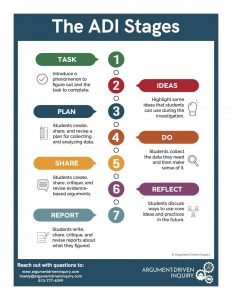
Image from Argument-Driven Inquiry, LLC.
The first workshop I attended was on this framework for designing science labs and classroom activities. It was unfortunately a bit rushed due to the technical meltdown that delayed it for 40 minutes, but well worth the time. The presenter was Todd Hutner, a professor at the University of Alabama.
The thing that grabbed me about this session was the emphasis on presenting evidence, collaborating with peers, and communicating ideas. The framework seems well-developed and supported by university research, so there are a lot of materials floating around for it. The National Science Teachers Association carries a number of books with lab investigations for a variety of disciplines and age groups. I picked up the Earth and Space Science one to try out for my current earthquakes unit, and will be sure to post about how it goes. (N.b., I’m not sponsored, I’m just shilling on my own time)
One of my favourite parts of the session was when he introduced double-blind peer review materials. This is something you don’t often see in a junior science setting, and I’m very excited to give it a go myself!
Archaeology, First Peoples History, and Science
Archaeologist Nicole F. Smith gave this workshop and it was a real eye-opener. She gave me so many ideas I never would have thought about for integrating indigenous history and worldviews into my practice.
First, she introduced us to the Húy̓at website. This website explores the history, archaeology, and narratives surrounding this site near Bella Bella, as told by the Heiltsuk people who live and lived there. This project is stunning and includes a teacher guide with BC curriculum connections to Science 9 and Social Studies 9.
Next, she introduced some resources around stone tools, and talked about how we can use these to explore the rock cycle and discuss rock types in our local area. The first resource was from the Royal BC Museum – this resource discusses stone tools and what we can learn from them. One of the connections I found most interesting was using stone tools to identify local rocks and to determine whether the local peoples obtained materials locally or traded with outside groups. She also shared the Reciprocal Research Network website, which allows you to search First Nations archaeological finds from 29 BC-based organizations, including museums, universities, and local tribal councils, as well as the Below BC Interactive Geological Map. Lucky me, the Reciprocal Research Network includes the Sto:lo Research & Resource Management Centre and the Chilliwack Museum and Archives, so local connections abound!
Last, she quickly shared some resources around clam gardens, including the Clam Garden Network and Junior Sea Doctors. I haven’t yet had a chance to check these out very much, but I know that FNESC’s two Science First Peoples resources also have quite a few connections to clam gardens on the coast.
Digital Data Analysis in Science
This one was a little less exciting for me, as it discussed ways of incorporating data collection and analysis through things like micro:bit and Arduino, but then the presenter started talking about Jupyter notebooks and the Callysto platform, and I got REALLY excited.
Jupyter notebooks are “documents containing formatted text interspersed with run-able Python code.” This allows you to create guided and student-editable data analysis using Python, which means, among other things, that you can perform complex operations with big datasets from government sources. Callysto is a free, non-profit platform for hosting Jupyter notebooks for educational use. They also have workshops and hackathons for teachers and students, as well as pre-made notebooks for school use.
Callysto is run by a local Canadian university group, the Pacific Institute for the Mathematical Sciences, so should in theory be FOIPPA-compliant, but I’ve sent out an email to double-check. I will update when I find out for sure about server locations.
Weaving Together Scientific Research and Indigenous Knowledge
The lovely folks at the Canadian Light Source (a synchrotron and research facility at the University of Saskatchewan) put together a presentation on some of the ways they are trying to integrate their research facility and indigenous knowledge. A big part of this presentation was focused on shifting from trying to bring indigenous knowledge into the western framework and more towards looking at how the synchrotron facility can support indigenous communities, elders, scientists, and knowledge keepers from within their own cultural framework. It was a great case study in how to acknowledge and include other frameworks for science beyond the western academic framework. It’s a big work-in-progress for me as an educator, but I feel really inspired by some of the things I’ve seen in this presentation.
They have some great programs (both online and on-site) for high school, but also have some other curriculum resources available for general teacher use. A highlight for me was a beaded medallion used to teach unit conversion. As always with these things, it’s best to reach out and find ways to connect these to local people and traditions.